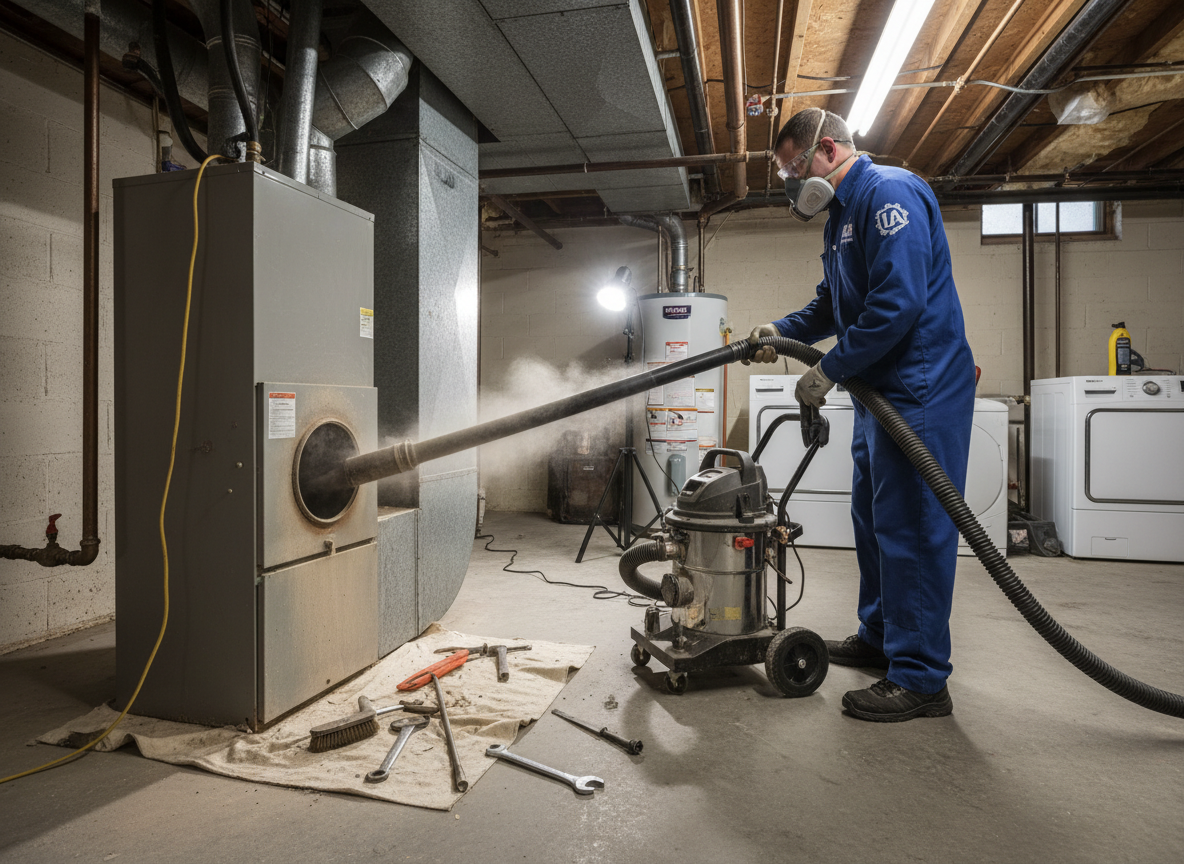
Upper Arlington homes built from the 1920s through 1970s in neighborhoods like Arlington Ridge and Tremont often feature galvanized steel ducts routed through crawl spaces and attics that experience wide temperature swings. These ducts collect fine silt from the region's loamy Franklin County soils plus combustion byproducts from gas furnaces that run hard during winter. A proper furnace and duct cleaning removes this buildup without disturbing the original duct seams or insulation that many homes still retain.
Spring pollen from Northam Park and the tree canopy along Reed Road enters return grilles and settles in the main trunk lines before summer humidity turns it into a sticky layer. In River Ridge properties near the Olentangy River corridor, higher moisture levels can promote mold on fiberglass duct board if the furnace blower runs continuously. Cleaning must include the furnace cabinet, blower wheel, and evaporator coil housing to prevent re-circulation of spores once the system restarts in fall.
Worthington and Grandview Heights border properties share the same municipal grid but often have different duct layouts due to varying lot slopes. Technicians working from the 3855 Reed Road base account for these micro-variations by mapping each run before vacuuming, ensuring negative pressure does not pull debris into living spaces near the Upper Arlington Public Library or Municipal Center.
Four distinct seasons mean the system cycles between heating and cooling modes, loosening debris that only becomes visible during changeover. Cleaning performed before the first hard freeze prevents restricted airflow that forces furnaces to short-cycle on cold Franklin County nights.
Technician insight
In Upper Arlington, the thing that catches most people out with furnace and duct cleaning is how many 1950s-60s homes in Arlington Ridge and Tremont still have original duct board in unconditioned attics that swells and cracks when winter temperatures drop below freezing, letting insulation fibers into the airstream if you agitate too aggressively.
Tremont Home with Restricted Airflow
Homeowner reported weak heat on the second floor during early December. Inspection found compacted dust and leaf debris from nearby Northam Park blocking the main trunk where it passed through the attic. Negative-pressure vacuuming and targeted brushing cleared the line without disturbing the original insulation. System airflow returned to normal and the furnace stopped short-cycling.
How it works
- 1
Initial System Inspection
Map all supply and return runs, note access points in attics and crawl spaces, and check furnace condition before any equipment enters the home.
- 2
Negative-Pressure Setup
Connect HEPA-filtered vacuum to the main trunk and isolate sections to prevent dust migration into living areas during agitation.
- 3
Mechanical Agitation and Vacuuming
Use rotating brushes sized for each duct diameter to dislodge debris, followed by continuous vacuum extraction from the furnace cabinet outward.
- 4
Furnace Component Cleaning
Remove and clean blower wheel, vacuum heat exchanger surfaces, and wipe interior cabinet walls without disturbing gas lines or electrical connections.
- 5
Final Verification
Reassemble, run the system through a full cycle, and confirm airflow at each register before leaving the property.
Pricing
Pricing depends on home size, number of stories, and duct access difficulty. Upfront quotes provided after inspection.