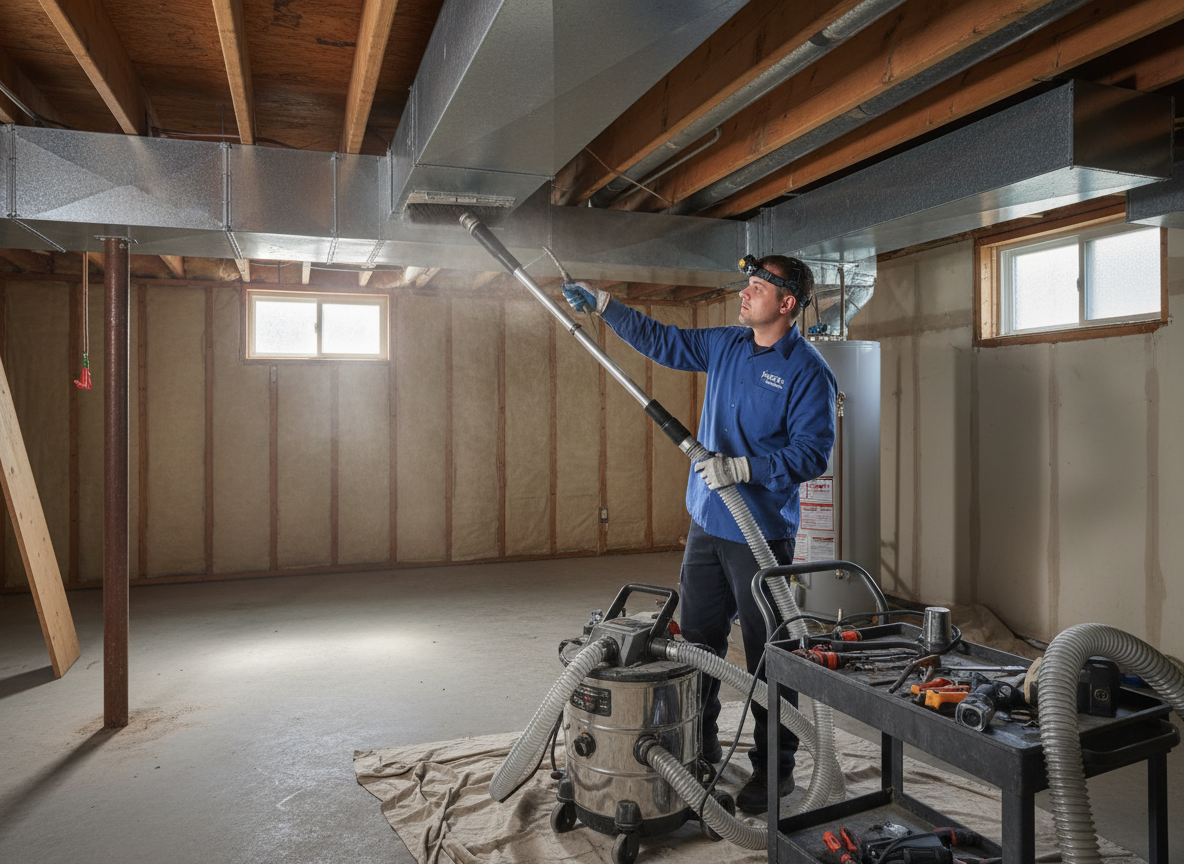
Upper Arlington homes built after World War II in neighborhoods such as Arlington Ridge and Tremont often feature original galvanized duct runs that run through tight crawl spaces and attics. These systems collect pollen during spring blooms and fine dust stirred by summer humidity, then trap it again when furnaces kick on during Franklin County winters. Cleaning requires removing registers without damaging plaster ceilings common in these houses and using brushes sized for the narrow 6-inch branches that feed rooms near Northam Park.
Four distinct seasons create repeated expansion and contraction in metal ducts, loosening joints over decades. Homeowners near the Upper Arlington Public Library and River Ridge frequently notice uneven airflow on second floors because debris settles at low points where the terrain is nearly flat. Technicians must map every branch before vacuuming to avoid pushing particles into living spaces or dislodging insulation that was added during later renovations in Grandview Heights and Worthington.
Access points are limited in many Upper Arlington properties because basements sit close to the water table and exterior vents sit behind mature landscaping. Proper cleaning uses negative-air machines placed at the main trunk near Reed Road addresses to pull debris outward rather than circulating it through the HVAC system. Skipping this step leaves residue that re-enters the home the first time the blower runs after a cold snap.
Residents along Tremont and Arlington Ridge report that pet dander and cooking grease combine with seasonal pollen to form a sticky film inside return ducts. This film reduces efficiency and can trigger allergy symptoms that persist until the entire run from the furnace to each register is agitated and extracted. Work in these homes always includes a final camera check to confirm no loose insulation or construction debris remains before the system is returned to service.
Technician insight
In Upper Arlington, the thing that catches most people out with HVAC duct cleaning is the narrow original ductwork in Arlington Ridge and Tremont homes; those 6-inch branches sit behind finished walls and collect sticky pollen-dust mix from humid summers that standard shop-vac attempts never reach.
River Ridge Home with Uneven Airflow
A homeowner noticed weak airflow on the second floor after the first cold snap. Inspection revealed compacted debris at low points in the return runs common to flat lots near the library. Negative-air cleaning cleared the branches and restored balanced flow without disturbing nearby insulation.
How it works
- 1
Initial System Mapping
Technicians trace every supply and return run from the furnace through the home, noting access points and any low spots where debris collects due to the flat terrain in Upper Arlington.
- 2
Register and Vent Removal
Registers are carefully removed and labeled so plaster and trim around Northam Park homes stay undamaged during the job.
- 3
Agitation and Negative-Air Extraction
Rotating brushes and compressed air loosen buildup while a vacuum stationed outside pulls material out, protecting indoor air in older Franklin County houses.
- 4
Final Inspection and Reassembly
A camera inspection confirms clean ducts, registers are reinstalled, and the system is tested for balanced airflow before departure.
Pricing
Cost depends on number of runs, access difficulty in older homes, and whether returns need extra attention after seasonal pollen loads.